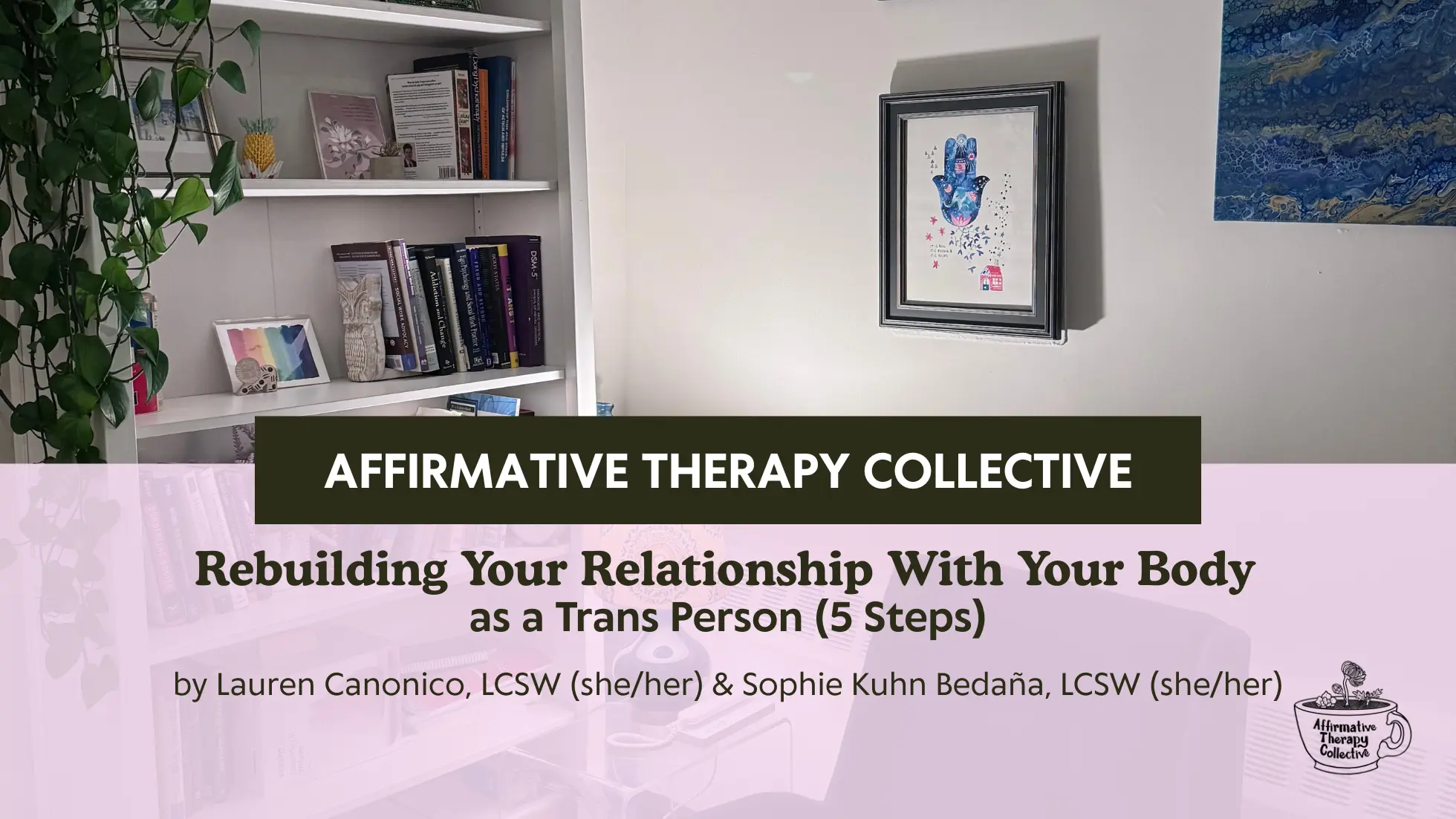
Rebuilding Your Relationship With Your Body as a Trans Person
5 Real Steps
Written in collaboration with Lauren Canonico, LCSW, Founding Director, and Sophie Kuhn Bedaña, LCSW, facilitator of Coming Home to You.
Your body doesn’t have to feel like someone else’s apartment you’re just crashing in.
That disconnect between who you are and what you see in the mirror has a name, and it isn’t a character flaw. Gender dysphoria and body image are tangled together for a lot of trans people, and people who identify as transgender are more vulnerable to body dissatisfaction. That’s not weakness. That’s you trying to figure out how to survive in a body that hasn’t caught up to your gender yet.
This isn’t a “just love yourself” post. This is a real map for what it actually looks like to come home to your body, your relationships, and your boundaries, on your timeline.

Navigating Body Image When Your Body Doesn’t Feel Like Yours Yet
You are not overreacting. You are not “too sensitive” about your body. And you are definitely not the only one who catches their reflection and feels like a stranger is staring back.
Body image for non-binary and trans people is expansive, tied to gender dysphoria for some, and connected to gender euphoria as people cultivate a body that feels more like their own. There isn’t one “correct” way to feel about your body as a trans person. Some days it’s rage. Some days it’s grief. Some days, post-haircut, a binder, a new name on a coffee cup, it’s pure euphoria.
Persistent gender dysphoria is linked to distress and body dissatisfaction in most people who seek care for it, and transition-related medical interventions like hormones or surgery can ease that dissatisfaction. But medical transition isn’t the only path, and it isn’t required for your feelings to be valid. Whether you’re years into HRT, saving for surgery, or not medically transitioning at all, your relationship with your body is allowed to be in process instead of at the finish line.
What actually helps here:
Naming the specific parts of your body that feel disconnected, instead of a vague “I hate my body.” Specificity gives you and a therapist something to actually work with.
Separating body image work from weight or size goals. This is about congruence with your gender, not about shrinking or reshaping yourself to fit anyone else’s idea of what trans bodies “should” look like.
Building a relationship with a gender affirming therapist who won’t flinch, redirect, or make you educate them mid-session.

Dating as a Trans Person: Navigating Disclosure, Safety, and Intimacy
Disclosure is not a moral obligation. It’s a safety decision, and you get to make it on your own terms.
There is no universal script for when or how to tell someone you’re dating that you’re trans. Some people share early. Some people share after they’ve built trust. Some people never share with someone they don’t plan to keep seeing, and that’s not dishonesty; that’s self-protection. What matters is that the decision is yours, made from a place of safety and readiness, not pressure.
Intimacy adds another layer. Body image struggles don’t disappear in the bedroom. Dysphoria can show up as avoidance, as needing certain things covered or certain language used, as a hard stop mid-moment (and as always, you don’t need any reason to make a hard stop mid-moment.). A good partner treats that as information, not rejection. Affirming therapy that’s actually built for trans bodies can help you figure out what intimacy looks like when it’s designed around your body instead of a cis-normative script you were never a match for.
A few things worth building into your dating life:
A short list of your own non-negotiables around disclosure, safety, and language, written down before you’re in the moment and your nervous system is running the show.
A plan for what you need if a date goes wrong, whether that’s a check in text to a friend or an exit strategy you decide in advance.
Language for intimacy that centers your body as it actually is right now, not the body you’re working toward or the body you used to have.

How Transition Affects Relationships With Partners, Family, and Friends
Transition doesn’t just change you. It changes the shape of every relationship around you, and some of those relationships were not built to hold the shift.
Partners may need to re-learn how to touch you, talk about you, and see you. Family may grieve a version of you that never actually existed, while missing the fact that you’re more yourself now than you’ve ever been. Friends might surprise you, either by showing up in ways you didn’t expect or by quietly drifting because your growth made them uncomfortable.
Social and family support are protective factors that buffer against the impact of minority stress, and family social support in particular has the strongest link to lower anxiety and depression and is the only support type tied to resilience once other supports are accounted for. That’s not a guilt trip toward family who haven’t caught up yet. It’s the opposite. It’s proof that the relationships you build on purpose- chosen family, a partner who does the work, a therapist who gets it- can carry real protective weight even when biological family lags behind or opts out entirely.
You don’t have to manage everyone’s timeline for accepting you. You get to protect your energy for the people actually doing the work to stay in your life.
Therapy offers a safe space to explore why you’re making certain emotional and energetic choices, understand where they’re coming from, differentiate them from people-pleasing, and make more intentional decisions about who you accommodate and who you don’t.

Setting Boundaries With People Who “Support You But…”
“I support you, but can you not tell your grandmother yet.” “I support you, but do you have to change your name at work.” “I support you, but this is a lot for me too.”
That sentence structure is a red flag disguised as an olive branch. Real support doesn’t come with a “but” attached to your safety, your name, or your timeline.
Boundaries with people like this aren’t about punishment. Boundaries protect relationships. Boundaries are the container you need to love both yourself and the other person at the same time. You’re telling someone exactly what you need in order to stay in a relationship with them, and then you’re watching what they do with that information. Some people adjust. Some people don’t. Both answers are useful.
A boundary script that actually works:
State the boundary plainly, without overexplaining or apologizing for taking up space. Example: “I need you to use my name and pronouns, including around family who don’t know yet.”
Name the consequence if the boundary isn’t respected, calmly and in advance. Example: “If that’s not something you can do, I’m going to need space from these conversations.”
Hold it, even when someone reacts with hurt feelings instead of accountability. Their discomfort with the boundary is not evidence that the boundary is wrong.

Work With Sophie B 1:1 – Join Coming Home to You

Some of this work happens best one-on-one. Some of it happens best in a room full of people who already get it, without you having to explain the basics first.
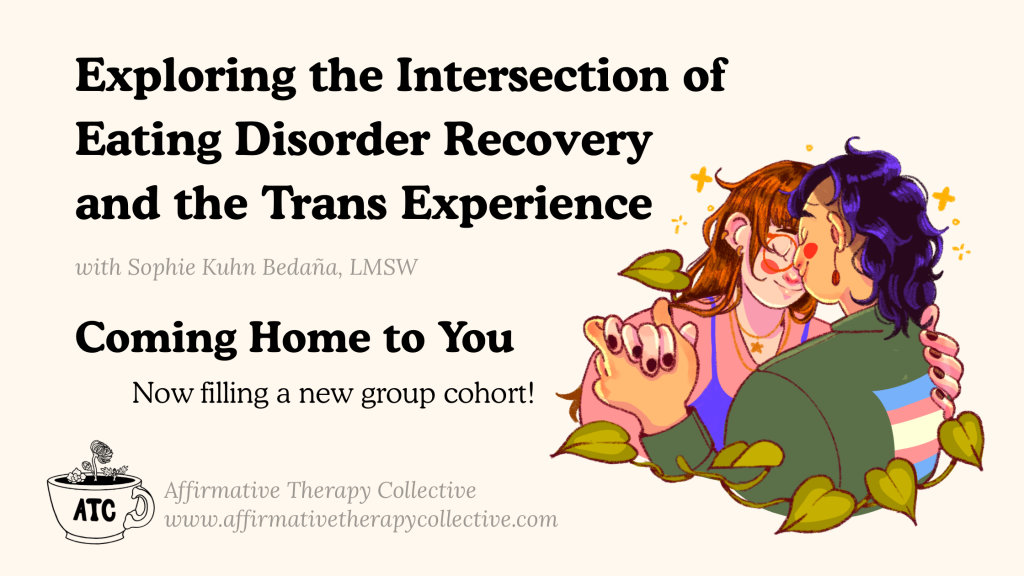
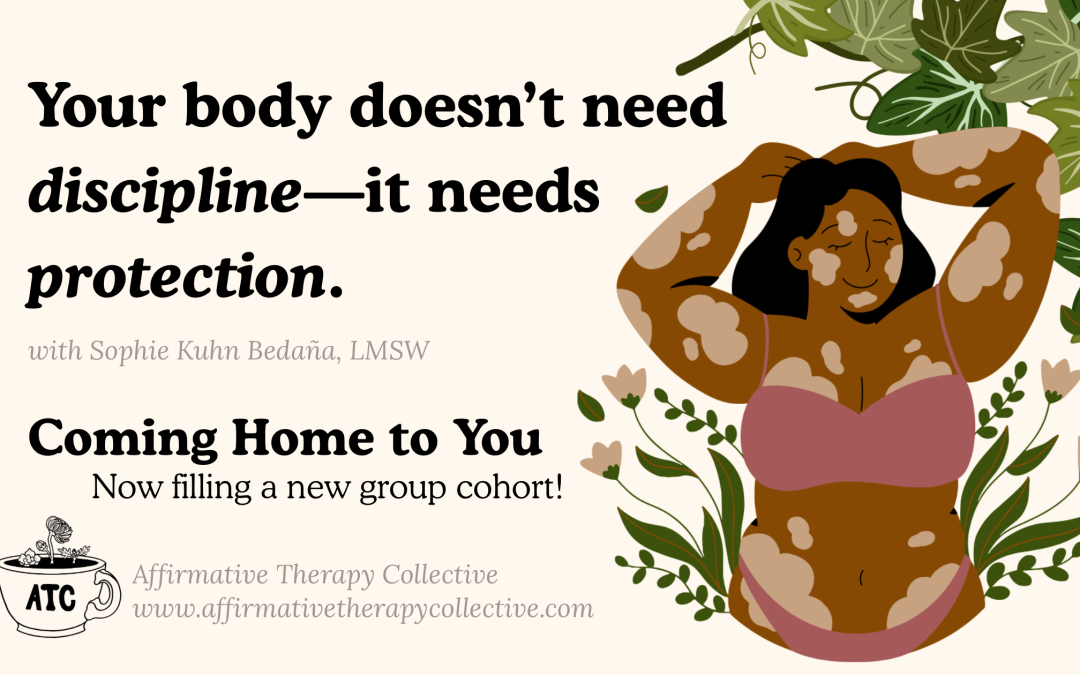
Sophie Kuhn Bedaña, LCSW specializes in neurodiversity affirming, body-liberation, and gender-affirming care, and she’s running Coming Home to You this fall, a closed cohort group therapy space built specifically for trans folks doing this exact work: body image, dating and disclosure, family and partner relationships, and boundaries that actually hold.
Spots are limited, and this cohort is filling up for fall.
If you know someone who needs this, tell them.
Start with a 1:1 consultation to talk through what fits you best: https://affirmativetherapycollective.com/contact
We offer a sliding scale for both individual and group work. Most insurance doesn’t cover this kind of care, and we don’t want cost to be the reason you sit this one out, so reach out and let’s figure out what’s possible.