Eating disorder treatment needs to change for gender-inclusive care
Eating disorders can be difficult for us all, but certain intersecting identities can bring along specific challenges that require specific understanding. One such identity is the trans experience, or identifying as transgender.
Please note that this conversation is inclusive of individuals who identify as non-binary or agender, even if someone doesn’t identify as trans.
Join Associate Therapist Sophie Kuhn Bedaña, LMSW in exploring the ways in which the trans experience can impact our relationship with food and our body.
Eating disorders are not one size fits all!
For many trans and nonbinary folks, eating disorders and body image struggles don’t exist in isolation. Instead, our relationship with food and our bodies are deeply connected to gender dysphoria, social visibility, safety, access to care, and how our bodies are read by others.
In working with trans individuals who have eating disorders or have otherwise struggled with disordered eating, it is essential to address and acknowledge this reality, instead of asking you to separate your eating behaviors from your gendered experience. It simply isn’t reasonable! Rather, we explore these connections with care, curiosity, and respect for the ways your body has helped you survive. Even if some of those ways weren’t always the most kind.
As clinicians, we must also consider the ways in which gender expression and identity complicate body image and body dissatisfaction. It’s important to remember that while eating disorder clinicians may focus on fatphobia and diet culture’s impact on our relationship with food in treatment, when working with trans folks it is essential to consider how gender dysphoria factors into a client’s body image preoccupations. If we ignore this piece, we run the risk of causing harm and setting someone’s recovery back.
Eating Disorders and Health at Every Size
A practice grounded in Health at Every Size, anti-diet and anti–fat bias frameworks, self-compassion, and strengths-based care, ATC clinicians reject the idea that bodies need to be controlled, disciplined, or corrected in order to be worthy of care. Rather, treatment focuses on helping you find safer, more sustainable ways to inhabit your body and relate to food—in whatever size body you may have.
This is because regardless of someone’s gender identity, a Health at Every Size approach allows us to create more space for our bodies to exist as they are, even if there are distressing pieces that may require attention. It also allows us to begin differentiating between restriction and care.
By using tools like intuitive eating—alongside the realities of needing structure, predictability, or practical nutrition support—we look at how food rules may have developed as coping or survival strategies. Only then can we begin rebuilding trust with your body, without the pressure to “fix” or change it.
There’s nothing wrong with your body. It doesn’t need fixing! It needs safety, respect, and autonomy. You deserve treatment that honors your body experience, in all of its complexities.
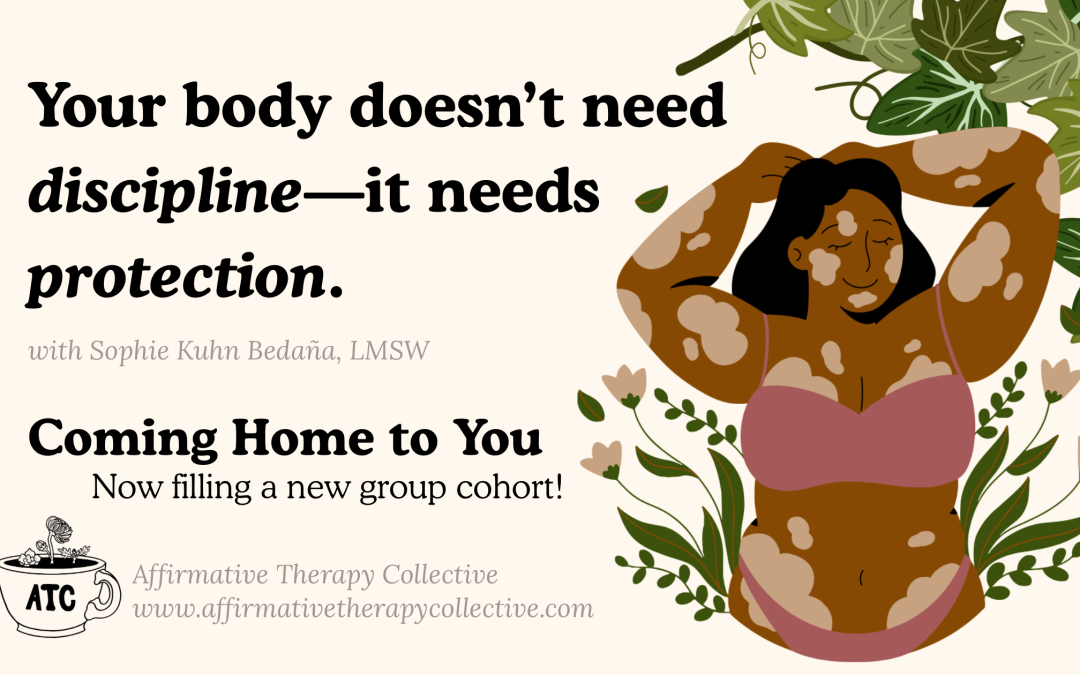
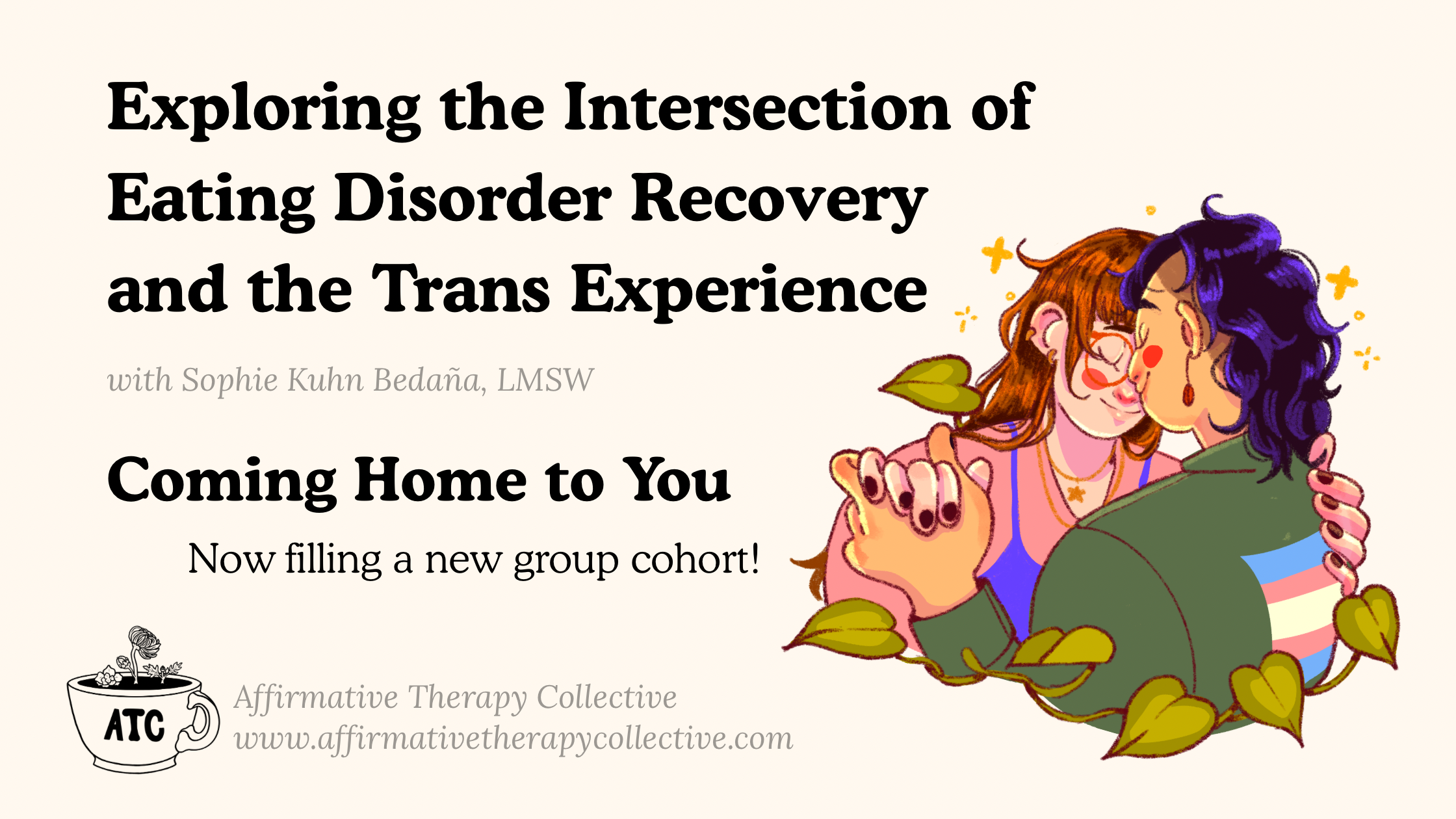
Curious about exploring the intersection between your trans identity and your eating behaviors? Sophie is currently running enrollment for a second cohort of her 6 week group focused on this experience!
Coming Home to You, a close-ended group focused on the trans experience of navigating food challenges and body image disruption.
What can I expect?
You will be invited to reflect, create, notice bodily sensations, or share stories. Participation is always at your pace! This is a space that honors different communication styles, energy levels, and neurodivergent needs. We will also explore additional intersections, such as chronic pain, relationships, and religion if applicable to group members.
I’m neurodivergent. Is this group right for me?
Many trans and nonbinary people are also neurodivergent, and neurotype can profoundly shape relationships with food, the body, and self-trust. In this group, we explore how sensory differences, interoception (noticing hunger, fullness, pain, or fatigue), executive functioning, and a need for predictability can impact body image and eating patterns. We talk about body image injury that comes from being misunderstood, pathologized, or the expectation of overriding your nervous system’s needs, as well as the internalized shame that can follow.